
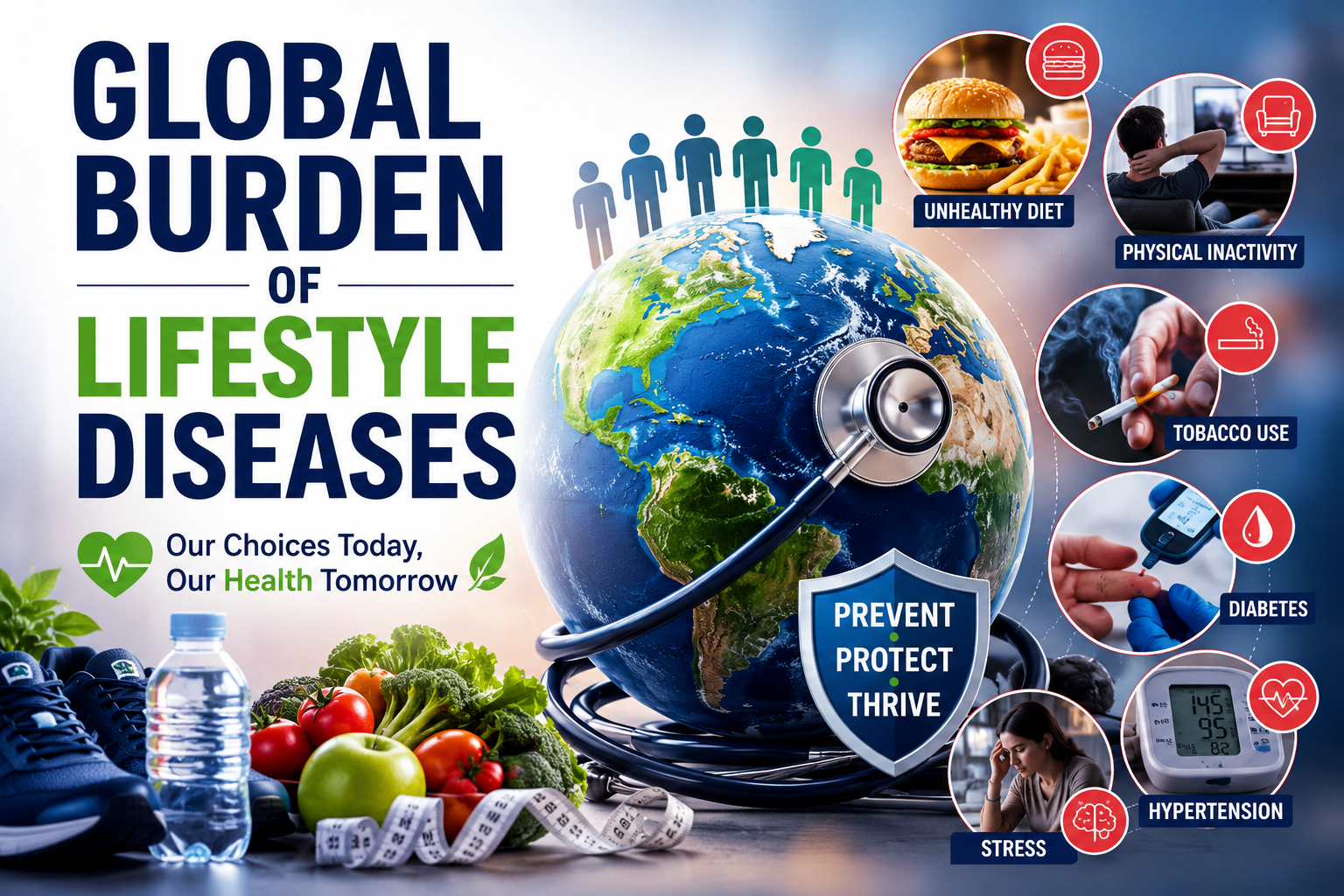
The Growing Burden of Lifestyle Diseases: A Global Public Health Challenge
Lifestyle diseases are rapidly becoming one of the greatest public health challenges of the 21st century. Across both developed and developing nations, healthcare systems are witnessing a significant rise in chronic conditions linked to lifestyle, behaviour, and environmental factors. Diseases such as obesity, type 2 diabetes, cardiovascular disease, hypertension, chronic respiratory illness, and certain cancers are contributing to increased mortality, reduced quality of life, and rising healthcare expenditure worldwide [1].
At Vitascan Health, we believe that understanding and addressing lifestyle diseases through prevention, early intervention, and community-based healthcare is essential for improving long-term global health outcomes.
Understanding Lifestyle Diseases
Lifestyle diseases, also known as non-communicable diseases (NCDs), are conditions largely associated with modifiable risk factors including poor diet, physical inactivity, tobacco use, harmful alcohol consumption, chronic stress, and environmental exposure [2].
According to the World Health Organisation, non-communicable diseases account for approximately 74% of all deaths globally, making them the leading cause of mortality worldwide [3]. Cardiovascular diseases alone are responsible for nearly 18 million deaths annually, followed by cancers, respiratory diseases, and diabetes [3].
Unlike infectious diseases, lifestyle diseases often develop gradually over time and can remain undetected for years before symptoms become severe. This makes prevention and early detection critically important.
Why Are Lifestyle Diseases Increasing?
Sedentary Lifestyles and Physical Inactivity
Technological advancement and urban living have significantly reduced physical activity levels across populations. Sedentary work environments, increased screen time, reliance on motorised transport, and reduced recreational activity contribute to declining physical fitness worldwide [4].
Physical inactivity is strongly associated with obesity, hypertension, cardiovascular disease, musculoskeletal disorders, and diabetes. Research suggests that insufficient physical activity is one of the leading preventable causes of chronic disease globally [5].
Poor Nutrition and Rising Obesity
Dietary habits have changed dramatically over recent decades. Increased consumption of processed foods, sugar-sweetened beverages, high-fat diets, and fast food has contributed to rising obesity rates worldwide [6].
The World Health Organization estimates that global obesity rates have nearly tripled since 1975 [7]. Obesity is a major risk factor for diabetes, cardiovascular disease, stroke, certain cancers, and reduced life expectancy.
Unhealthy diets also contribute to micronutrient deficiencies, metabolic disorders, and poor overall health outcomes.
Tobacco and Alcohol Consumption
Smoking remains one of the leading preventable causes of death globally. Tobacco use increases the risk of lung disease, cardiovascular disease, stroke, and multiple forms of cancer [8].
Excessive alcohol consumption is similarly associated with liver disease, hypertension, mental health disorders, and injuries. Despite growing awareness, tobacco and alcohol-related illnesses continue to place substantial pressure on healthcare systems worldwide.
Mental Health and Chronic Stress
Modern lifestyles are increasingly associated with chronic stress, burnout, social isolation, financial insecurity, and mental health challenges. Mental health conditions such as anxiety and depression frequently coexist with physical health conditions, increasing overall disease burden and healthcare demand.
There is growing recognition that mental and physical health are deeply interconnected and must be addressed through integrated preventive healthcare approaches.
Urbanisation and Environmental Risks
Rapid urbanisation has created environmental and occupational health challenges, including air pollution, overcrowding, limited green spaces, and unhealthy living conditions [9].
Air pollution alone contributes significantly to respiratory disease, cardiovascular disease, and premature mortality globally. Environmental risk factors are becoming increasingly important contributors to the burden of lifestyle-related illness.
The Impact on Global Healthcare Systems
The growing prevalence of lifestyle diseases has major implications for healthcare systems, economies, and societies.
Chronic diseases often require:
- Long-term treatment
- Repeated hospital admissions
- Continuous medication
- Ongoing monitoring
- Rehabilitation and support services
This creates substantial healthcare expenditure and increases pressure on healthcare professionals and hospital capacity.
The National Health Service Long Term Plan highlights prevention as a critical strategy for reducing avoidable illness and managing increasing healthcare demand [10]. Similar challenges are being experienced globally as healthcare systems struggle to balance acute care with long-term chronic disease management.
Lifestyle diseases also reduce workforce productivity, increase disability rates, and contribute to wider social and economic inequalities.
The Importance of Preventive Healthcare
Many lifestyle diseases are preventable through early intervention and public health action. Preventive healthcare focuses on identifying risk factors before serious illness develops and empowering individuals to make healthier choices [11].
Preventive strategies include:
- Regular health screening
- Smoking cessation programmes
- Nutritional education
- Physical activity promotion
- Mental health support
- Community health outreach
- Workplace wellness initiatives
Early detection of hypertension, obesity, elevated blood glucose levels, and respiratory risk factors can significantly reduce future complications and improve health outcomes.
At Vitascan Health, we support preventive healthcare approaches that prioritise early intervention, health education, and accessible community-based services.
Community-Based Prevention and Public Health
Community-focused healthcare initiatives are essential for tackling lifestyle diseases effectively. Healthcare services delivered directly within communities improve accessibility, encourage participation in screening programmes, and help reduce health inequalities [12].
Examples of community-based prevention include:
- Mobile health screening services
- Lung health assessments
- Public health awareness campaigns
- School health education
- Smoking cessation outreach
- Workplace wellbeing programmes
These initiatives promote early engagement and encourage healthier behaviours before chronic disease develops.
Technology and the Future of Prevention
Digital health innovation is transforming preventive healthcare globally. Wearable technologies, mobile health applications, telehealth platforms, and portable diagnostic devices are improving healthcare accessibility and enabling earlier intervention [13].
Technology-driven prevention can:
- Improve patient engagement
- Support remote monitoring
- Enhance early diagnosis
- Increase access to screening
- Strengthen healthcare efficiency
The integration of digital health tools into preventive healthcare strategies may play a major role in reducing the future burden of lifestyle diseases.
Building Healthier Societies
Addressing lifestyle diseases requires collaboration between healthcare providers, governments, employers, educators, and communities. Public health policies that promote healthier environments, improve access to preventive care, and address social determinants of health are essential for sustainable change [14].
The future of healthcare depends not only on treating disease but on preventing it before it begins.
At Vitascan Health, we remain committed to supporting preventive healthcare initiatives that strengthen communities, improve health awareness, and contribute to healthier futures worldwide.
Bibliography
1.Brauer M, Roth GA, Aravkin AY, Zheng P, Kalkidan Hassen Abate, Yohannes Habtegiorgis Abate, et al. Global burden and strength of evidence for 88 risk factors in 204 countries and 811 subnational locations, 1990–2021: a systematic analysis for the Global Burden of Disease Study 2021. Lancet [Internet]. 2024 May 1;403(10440):2162–203. Available from: https://www.thelancet.com/journals/lancet/article/PIIS0140-6736(24)00933-4/fulltext
2.WHO. Global Action Plan for the Prevention and Control of NCDs 2013-2020 [Internet]. www.who.int. 2013. Available from: https://www.who.int/publications/i/item/9789241506236
3.World Health Organization. Noncommunicable diseases [Internet]. World Health Organization. 2024. Available from: https://www.who.int/news-room/fact-sheets/detail/noncommunicable-diseases
4.World Health Organization . Physical activity [Internet]. World Health Organization. 2024. Available from: https://www.who.int/news-room/fact-sheets/detail/physical-activity
5.Booth FW, Roberts CK, Laye MJ. Lack of Exercise Is a Major Cause of Chronic Diseases. Comprehensive Physiology [Internet]. 2012 Apr;2(2). Available from:
https://pmc.ncbi.nlm.nih.gov/articles/PMC4241367/
6.Malik VS, Popkin BM, Bray GA, Després JP, Willett WC, Hu FB. Sugar-sweetened Beverages and Risk of Metabolic Syndrome and Type 2 diabetes: a meta-analysis. Diabetes Care [Internet]. 2010 Nov;33(11):2477–83. Available from:
7.World Health Organization. Obesity and Overweight [Internet]. World Health Organization. 2025. Available from:
https://www.who.int/news-room/fact-sheets/detail/obesity-and-overweight
8.No Tobacco (TFI. WHO global report on trends in prevalence of tobacco use 2000–2024 and projections 2025–2030 [Internet]. Who.int. World Health Organization; 2025. Available from:
https://www.who.int/publications/i/item/9789240116276
9.World Health Organization. Preventing disease through healthy environments: a global assessment of the burden of disease from environmental risks [Internet]. www.who.int. 2018. Available from:
https://www.who.int/publications/i/item/9789241565196
10.UK Government Web Archive [Internet]. Nationalarchives.gov.uk. 2025. Available from:
11.Kisling LA, Das JM. Prevention Strategies [Internet]. www.ncbi.nlm.nih.gov. StatPearls Publishing; 2022. Available from:
https://www.ncbi.nlm.nih.gov/books/NBK537222/?report=printable
12.Marmot M, Allen J, Boyce T, Goldblatt P, Morrison J. Health Equity in England: the Marmot Review 10 Years On [Internet]. Institute of Health Equity; 2020. Available from:
13. Cao HY, Ma D. Digital Health: Transforming Healthcare Through Technology. Praxishandbuch Digitales Management [Internet]. 2025 Nov 14;1–17. Available from:
https://link.springer.com/rwe/10.1007/978-3-658-46399-1_21-1
14.Alderwick H, Hutchings A, Mays N. Cross-sector collaboration to reduce health inequalities: a qualitative study of local collaboration between health care, social services, and other sectors under health system reforms in England. BMC Public Health [Internet]. 2024 Sep 27;24(1):1–19. Available from:
https://bmcpublichealth.biomedcentral.com/articles/10.1186/s12889-024-20089-5